The Short Happy Shelf Life of CD-ROMs
For a brief period in the 1990s, CD-ROMs made possible a new form of creative medium from a unique type of creative person.
In the 1980s, the personal computer could be used to process words, maintain spreadsheets, organize databases, play games, do early desktop publishing, and access online services. By the early 1990s, there was a color screen, video, animation, photographs, recorded sound, and enough storage to contain entire libraries of text and images. The machine had evolved to display nearly every medium.
What might an artist do with that?
Or a novelist? A filmmaker? An architect, historian, cartoonist, scientist, educator, publisher, game designer, or collector?
The interactive multimedia CD-ROM was born within this opening. It was not simply a storage format or an early version of the website. It was an attempt to create an entirely new cultural object, part book, film, game, museum exhibition, archive, classroom, and cabinet of curiosities.
No profession fully owned it. No settled grammar governed it. No dominant platform had standardized its design.
That made it a perfect new medium for polymaths.
The Ultimate Polymath, Byron Preiss
Byron Preiss was the ultimate polymath.
He was born in Brooklyn in 1953, studied at the University of Pennsylvania and Stanford, and started Byron Preiss Visual Publications to publish illustrated books, comics, science fiction, children’s literature, and experimental combinations of words and images. His projects included early graphic novels, literary adaptations, educational comics, shared fictional universes, treasure hunts, celebrity books, and electronic publishing (legacy.com).
He did not fit cleanly into the established role of publisher.
Traditional publishers generally acquired books that authors had already conceived. Byron often began with the idea itself. He would identify a subject, imagine a format, obtain the necessary rights, and assemble the writers, artists, researchers, designers, producers, and publishing partners required to make it real.
Carl Reiner described him as a kind of marriage broker for people and ideas. Jack Romanos of Simon & Schuster said Byron could see books where other people did not, and see them in forms other people had not imagined. (publishersweekly.com)
Byron’s great talent was not specialization. It was synthesis.
He saw the comic inside the educational problem, the children’s book inside the comedy routine, the game inside the science-fiction premise, the physical adventure inside the illustrated book, and the future medium inside the emerging computer.
His passions included science fiction, robots, dinosaurs, science, education, architecture, and history. His heroes included Isaac Asimov, Ray Bradbury, Frank Lloyd Wright, Albert Einstein, Raymond Chandler, Jack Kirby, Gahan Wilson, and Moebius. Long before geekdom became popular big business, Byron Preiss was elevating it to the place of art.
In 1992, he founded the Byron Preiss Multimedia Company in a loft office space in New York’s Flat Iron District.
The timing was perfect.
BPMC approached software as a publisher and producer rather than merely as a technology company.
BPMC would begin with an author, artist, archive, institution, subject, or fictional universe. It would develop the editorial concept, assemble the creative and technical team, and then work with larger companies such as Microsoft, Simon & Schuster Interactive, Penguin Electronic Publishing, Harry N. Abrams, and other partners to publish and distribute the finished product. (publishersweekly.com)
Its catalog was eclectic because multimedia itself was still undefined.
BPMC could make an interactive architectural monograph, an electronic literary edition, a historical archive, a children’s adventure, a science laboratory, a detective story, or a science-fiction game. All belonged to the same company because all asked variations of the same question:
What can this subject become when text, art, music, film, animation, archives, games, and user choice can occupy the same work?
BPMC was not following a mature market. It was testing the boundaries of an emerging medium.
The sheer range of BPMC’s work was part of its meaning. Today, that catalog might be divided among several industries:
- a game studio;
- an ebook or audiobook publisher;
- an educational-technology company;
- a streaming documentary producer;
- a podcast company;
- a museum-design firm;
- an archival database;
- a digital humanities project;
- and several licensed entertainment businesses.
At BPMC, they could exist within one imaginative institution.
This was possible because “multimedia company” had not yet hardened into a conventional business category. It meant what the words said: a company capable of working across media.
The medium briefly favored people who could move comfortably among disciplines.
A programmer alone could not make one of these works. Neither could an author, illustrator, historian, filmmaker, musician, publisher, researcher, or game designer.
But bring all of them together, and they might make something that had not previously existed.
That was Byron’s natural domain.
Isaac Asimov’s Ultimate Robot and Michael Crichton’s Westworld 2000
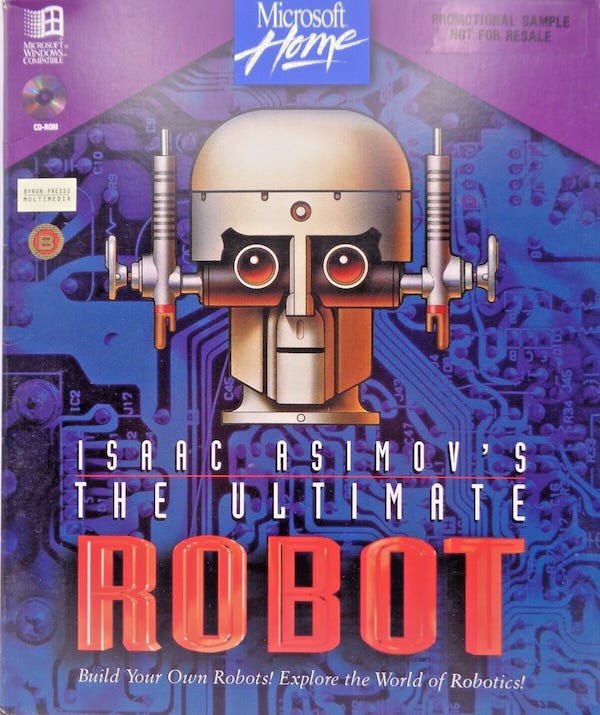
Isaac Asimov’s work was particularly well suited to Byron’s approach.
The Ultimate Robot assembled Asimov’s fiction and essays alongside material about real robotics, mechanical animation, photographs, science-fiction film clips, and an interactive toolkit through which users could build their own robots. It was published by BPMC and distributed by Microsoft.
BPMC later extended Asimov’s Robot City shared universe into a first-person interactive mystery. Its conversational and puzzle systems drew on the Three Laws of Robotics, the fictional rules governing how Asimov’s robots could behave. (en.wikipedia.org)
Westworld 2000 transformed Michael Crichton’s 1973 movie about artificial playground with humanoid robots into a first-person action game. Published by BPMC for Windows in 1996, the game invited players to enter its simulated environments as a gunslinger, samurai warrior, or intergalactic spy, fighting malfunctioning robots across worlds equipped with weapons drawn from the past, present, and imagined future. (mobygames.com)
These projects differed in style and form, but they shared Byron Preiss’s underlying conviction: a work of science fiction was not exhausted by its original text or film. It contained systems, landscapes, archives, voices, and unrealized paths that another interactive medium might reveal in new ways.
The Ultimate Frank Lloyd Wright and the Ultimate Einstein
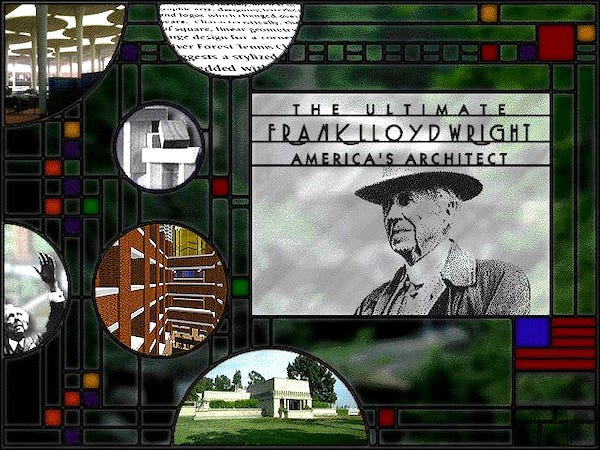
The Ultimate Frank Lloyd Wright is one of the clearest examples of what BPMC and the medium could achieve.
A conventional architectural book could present Wright’s life and buildings through text, plans, and photographs. The BPMC disc allowed the user to move among his buildings, geography, biography, philosophy, patterns, sculptures, and unrealized projects.
A user could begin with Wright’s Los Angeles houses, follow a connection to his decorative patterns, move into his architectural philosophy, and return to the buildings with a different understanding of what they represented.
The disc included virtual walking tours, including one through the demolished Larkin Administration Building, and a module that allowed users to experiment with Wright’s architectural building blocks. A contemporary Washington Post review concluded that the multimedia elements produced insights that another medium could not deliver and praised the interface as though Wright himself had designed it. (washingtonpost.com)
The Ultimate Einstein treated Albert Einstein not merely as the subject of a biography, but as the center of an explorable intellectual universe. Developed with the cooperation of the Einstein estate, the CD-ROM combined archival photographs, audio and video, biographical material, a searchable library, thought experiments, and interactive demonstrations of relativity. It captured the distinctive promise of multimedia: ideas ordinarily confined to equations and analogy could be animated, manipulated, and experienced. The user did not simply learn what Einstein thought, but entered a virtual laboratory designed to make the strange behavior of light, motion, space, and time momentarily visible.
Raymond Chandler’s Los Angeles
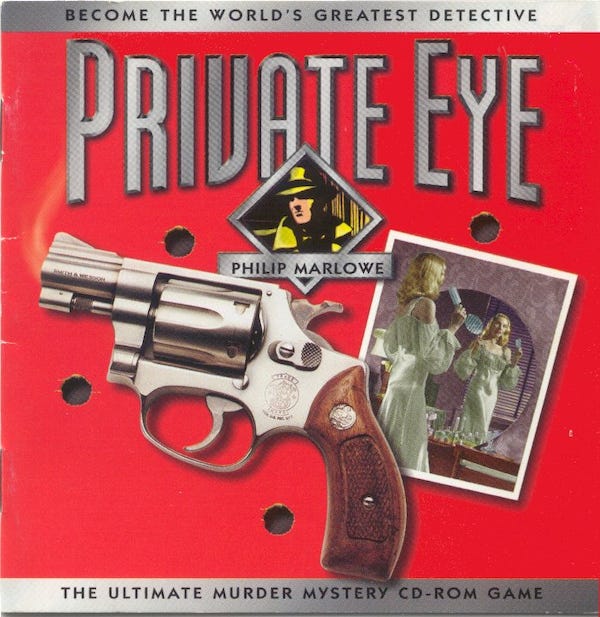
BPMC approached Raymond Chandler’s Los Angeles through two different forms.
Trouble Is My Business collected the eight Philip Marlowe novels with Chandler’s letters, maps, images, film material, audio, and a search engine. Readers could trace story locations across Los Angeles, search Chandler’s language, and read his correspondence in the context of the novels he was writing. (washingtonpost.com)
Philip Marlowe: Private Eye went further. Rather than exploring an archive about Marlowe, the user entered an interactive mystery. Players control Marlowe as he explores hand-drawn noir environments to gather clues and crack a murder case, complete with 1940s jazz music, full voice acting, and distinct alternate endings depending on the investigative choices you make.
One project turned the author’s world into a navigable literary archive. The other invited the reader to step inside the experience.
The Complete Multimedia Experience
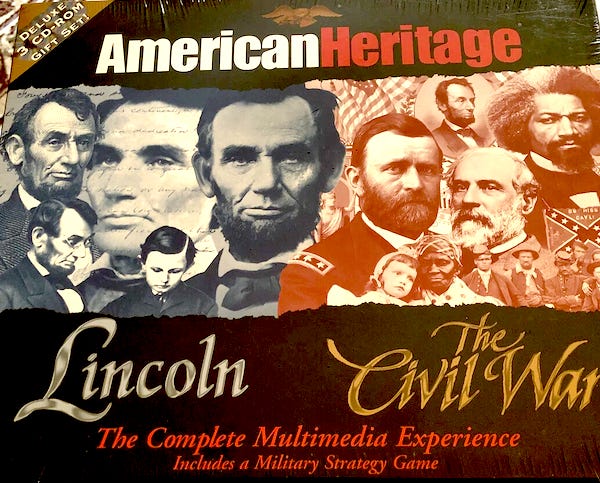
BPMC’s collaboration with American Heritage on The Civil War - The Complete Multimedia Experience demonstrated how completely the multimedia experience could could immerse someone in history.
The 3 disc set contained Bruce Catton’s narrative, literary works such as Uncle Tom’s Cabin and The Red Badge of Courage, hundreds of photographs, paintings, music, sheet music, battle maps, documentary material, and video featuring historical reenactors.
Richard F. Snow, then editor of American Heritage, approached the project skeptically. He had seen enough CD-ROMs that converted ordinary reference material into something more complicated and less useful.
The finished project changed his mind.
He found that the accumulation of maps, voices, music, artifacts, movement, and eyewitness accounts brought the human beings represented by military symbols back into view. The interactive multimedia CD-ROM experience could show the battlefield diagram and the exhausted people moving through the actual terrain at the same time. It suggested what Snow called the immense density of details that produces a historical moment. (americanheritage.com)
This was not a replacement for narrative history.
CD-ROMs became a format where evidence of different kinds media could remain distinct while still contributing to one whole understanding.
The Short Shelf-Life of CD-ROMs
The optimism surrounding multimedia was supported by a real and rapidly expanding market. U.S. sales of CD-ROM software reportedly grew by more than 200% in 1994, reaching approximately $640 million, while unit sales nearly tripled to 22.8 million discs. Computers equipped with CD-ROM drives were entering homes in rapidly increasing numbers. Publishers, software companies, game studios, museums, record labels, educational businesses, and Hollywood companies all began searching for their place in the new medium. Bookstore chains had entire interactive multimedia CD-ROM sections. (latimes.com)
But, the CD-ROM’s technological window was always likely to be temporary. Each title required a new combination of investment, resources, rights, research, editorial development, art, audio, video, animation, interface design, programming, testing, manufacturing, packaging, marketing, and physical distribution.
The World Wide Web and the web browser arrived. Digital distribution displaced boxed software. Games evolved into a mature and increasingly specialized industry. Reference information moved online. Standardized browsers and operating systems replaced individually designed interfaces as the ordinary gateways into digital culture.
The web did not merely defeat the CD-ROM. It divided its functions and distributed them across the network.
The book went one way.
The game went another.
The archive moved to institutional websites.
The classroom became an online course.
The conversation went to social media.
The search function went to Google.
The interface belonged to the platform.
Media became ubiquitous.
But multimedia as a distinct authored medium largely disappeared.
The web gave us access to more information than any CD-ROM producer with 650 megabytes of space could have imagined. It made global distribution nearly instantaneous and allowed knowledge to be updated continuously.
But the web did not preserve every quality of the earlier form.
A CD-ROM was finite. The user could understand, at least in principle, that someone had selected every piece of material, designed every relationship, and shaped the entire experience. It had a beginning and an edge, even if it did not have a predetermined path. Its limitations were part of its artistic appeal.
It is easy to tell the history of technology backward.
Once we know which format prevailed, everything else begins to look like a primitive attempt to reach the winner. The CD-ROM becomes an inferior website. Interactive literature becomes an immature game. Digital archives become databases waiting for broadband.
That interpretation mistakes survival for importance.
The interactive multimedia CD-ROM was not important because it anticipated every technology that followed. It was important because it made possible a new kind of creative work from a unique type of creative person. For a few years, the boundaries separating art, education, entertainment, scholarship, software, and business became unusually permeable.
And Byron Preiss Multimedia Company brought it all together.
Epilogue
Byron Preiss continued experimenting with new forms of publishing after the CD-ROM moment passed. Through iBooks and his other ventures, he pursued electronic books, digital distribution, comics, illustrated publishing, and further combinations of established culture with emerging technology. Colleagues remembered him as someone perpetually generating projects and connecting people who might never otherwise have worked together. (publishersweekly.com)
He died in an automobile accident on July 9, 2005, at the age of 52, just before smartphones, tablets, streaming media, modern ebooks, online fan communities, and eventually generative AI transformed the relationships among media once again. (legacy.com)
It is tempting to imagine what he might have done with the tools that followed.
But that risks overlooking what he actually accomplished.
Byron Preiss did not need to see the final technological future to have reached his creative moment.
For one brief period, the computer became exactly the kind of medium he had spent his life preparing for: visual, literary, interactive, educational, popular, experimental, and unconcerned with conventional boundaries.
He and his collaborators found themselves standing inside a form without traditions, fixed categories, or settled expectations.
They could ask what a book, game, film, museum, archive, classroom, and work of art might become when all of them could occupy the same interactive experience.
That was a happy time.